If a nuclear winter would occur, this would lead to the northern part of the world becoming very frosty for a decade. However, a nuclear winter does not have evenly distributed effects. Generally, the further you are away from the equator the worse the effect gets and the northern hemisphere fares worse, as it does have more land area, which cools faster. This means any nuclear winter will hit the northernmost countries in the northern hemisphere worst. Specifically, this means Russia, Canada, Iceland, Finland, Norway and Sweden would likely be having a particularly bad time. All of those except Russia do not even have nuclear weapons. In this post I want to give an overview of how this would impact temperature, food, water, frost and snow.
Temperature
The most obvious effect of nuclear winter is that sunlight reaching the Earth’s surface is reduced. As this limits the energy in the system, temperatures fall accordingly. The go to study to understand this better is Coupe et al. (2019). They used a full fledged climate model to model how a large nuclear war would impact global temperatures (Figure 1).
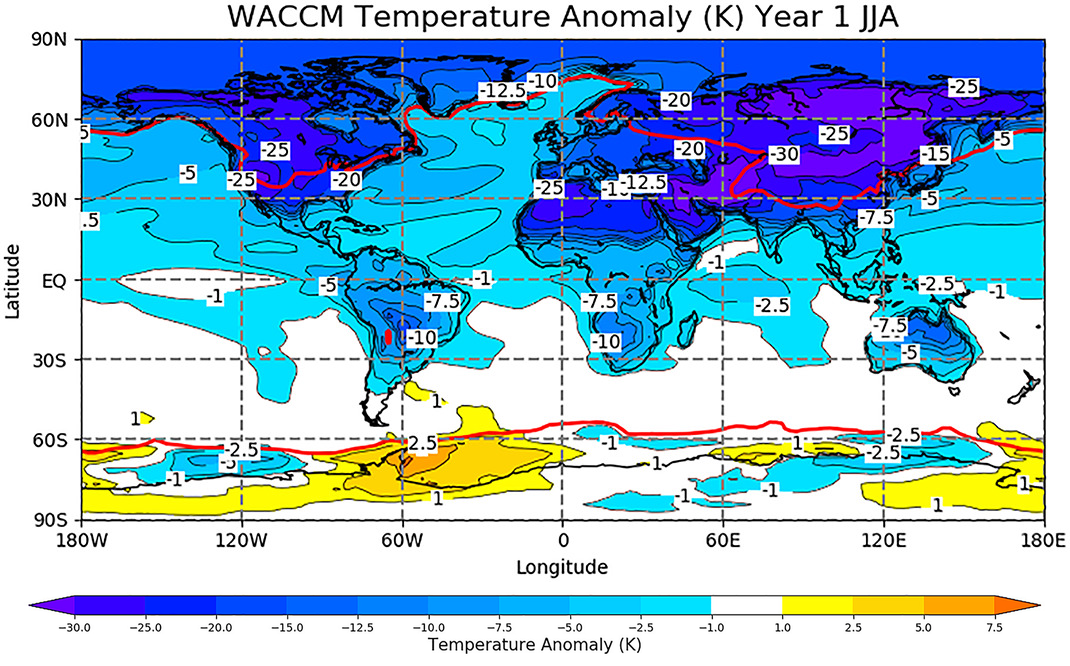
Figure 1: Temperature anomaly in the second summer after a 150 Tg nuclear war (June to August, Year 1), simulated with WACCM4 (Coupe et al., 2019). Red line: everything poleward has a mean summer temperature below 0°C.
This model shows that during the second year of nuclear winter summer temperatures would drop massively. Russia would be 25 to 30°C colder than normal, Canada around 25°C, Scandinavia around 20°C and Iceland around 12.5°C. All of these countries would experience temperatures below freezing, even in the middle of summer. While this run is assuming an all out nuclear war, the impacts are also bad after smaller nuclear exchanges.
The frost in summer is an especially big problem. A single frost in the growing season can wipe out the whole crop. This means even those areas that are above 0°C on average, would likely experience summer frosts that would make any conventional agriculture impossible.
Food
This change in temperature has pretty severe consequences for crop production. Blouin et al. (2025) modelled this for a variety of crops in the MINK crop model. They did this both under the assumption that farmers either don’t adapt and try to grow what they had been growing all along or by shifting by shifting to the crops that do best in the colder conditions (Figure 2).
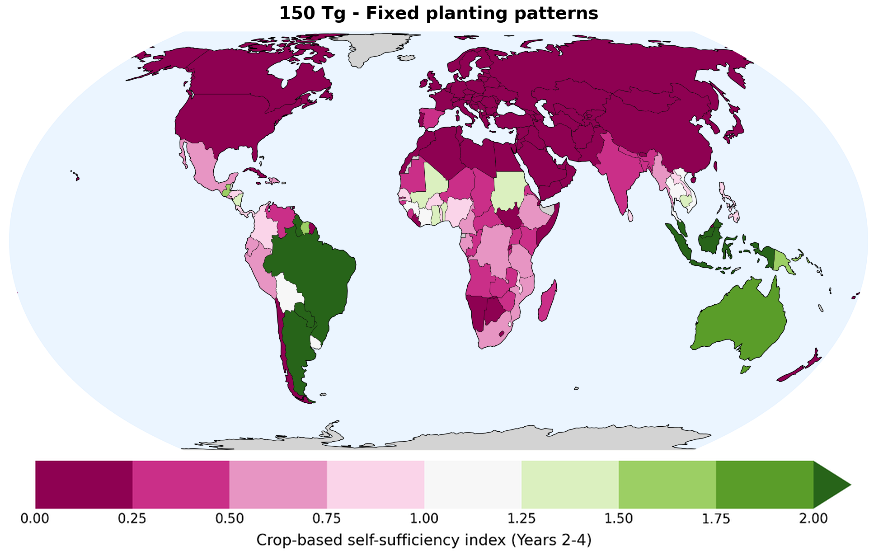
Figure 2: Crop-based self-sufficiency by country, averaged over years 2 to 4, with and without crop relocation (Blouin et al., 2025). 1.0 means enough crop calories to provide 2,300 kcal per person per day.
This works, especially for the less severe nuclear winters. In a 16 Tg nuclear war, this intervention alone could offset food production losses. However, it gets to its breaking point in the most extreme scenarios. The temperatures in a large chunk of the northern hemisphere just get too cold, no matter what plant you want to use. There just is not any crop that could grow and give yield in an environment where the temperature stays below 0°C in summer. This gets worse, the further north you get, as these are the places that are already using the most cold tolerant crops. They are already doing agriculture on the far edge. There are none even more cold tolerant crops they could switch to.
All this means that these northern countries would lose the majority of their local food production.
Water pipes
But this is not where the problems stop. Even more urgent needs would not be met. Frost depths change as a consequence of nuclear winter. Both by freezing deeper in places that already experience frost and by freezing further south in places that do not experience frost right now. A paper that looked into this is by Lamilla Cuellar et al. (2026). They used the climate data from Coupe et al. (2019) for the 150 Tg scenario to explore how this would affect drinking water infrastructure. First they looked at changes in frost depths (Figure 3).
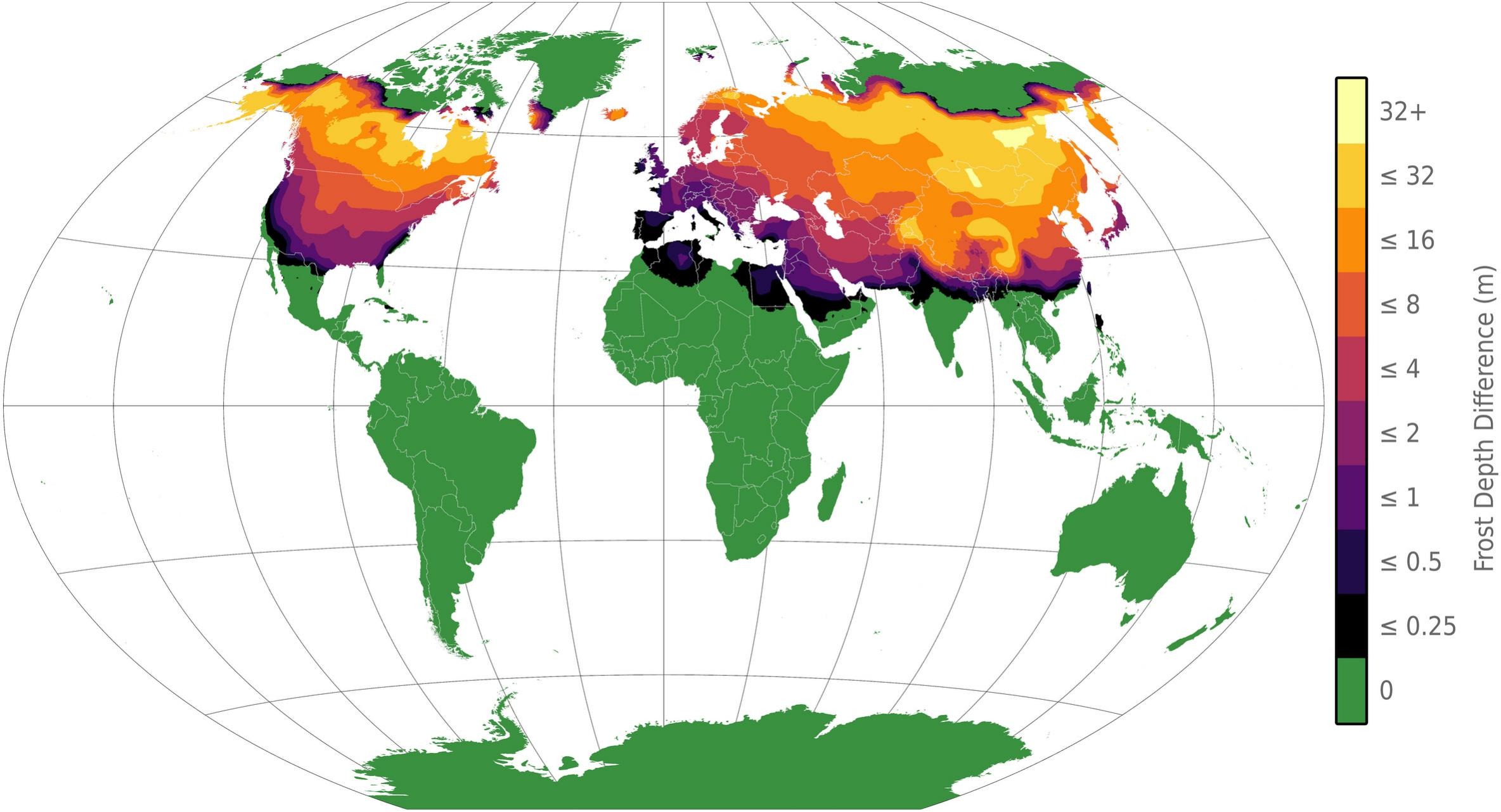
Figure 3: Changes in frost depths during a nuclear winter (150 Tg) in comparison to baseline.
This shows that the majority of urban areas north of the 25th parallel north would be impacted by an increasing frost depth. This is roughly the line that cuts through the middle of India, Mexico and Saudi Arabia. Buried infrastructure for water is usually located in a depth that is lower than then frost depths a region usually has. This way you do not have to insulate the piping much. However, if your frost depth increases, suddenly your unprotected water infrastructure starts to freeze, which can quickly lead to destruction. While this can be counteracted by insulating it more, e.g. by putting more soil on top of it, this is quite labor intensive and would have to be done on a massive scale. This could disrupt about 5 to 9 million km of pipe in 92 countries, serving about 2.1 billion people. Finland and Iceland have the most at-risk pipe per person of any country, with Norway close behind.
Snow
Though frost depth is not the only thing that intensifies. Snow cover also increases, as more of the precipitation falls as snow and the lower temperatures mean it takes longer to melt. Wöstenberg and Jehn (2026) modelled these snow dynamics to understand where they would change things (Figure 4).
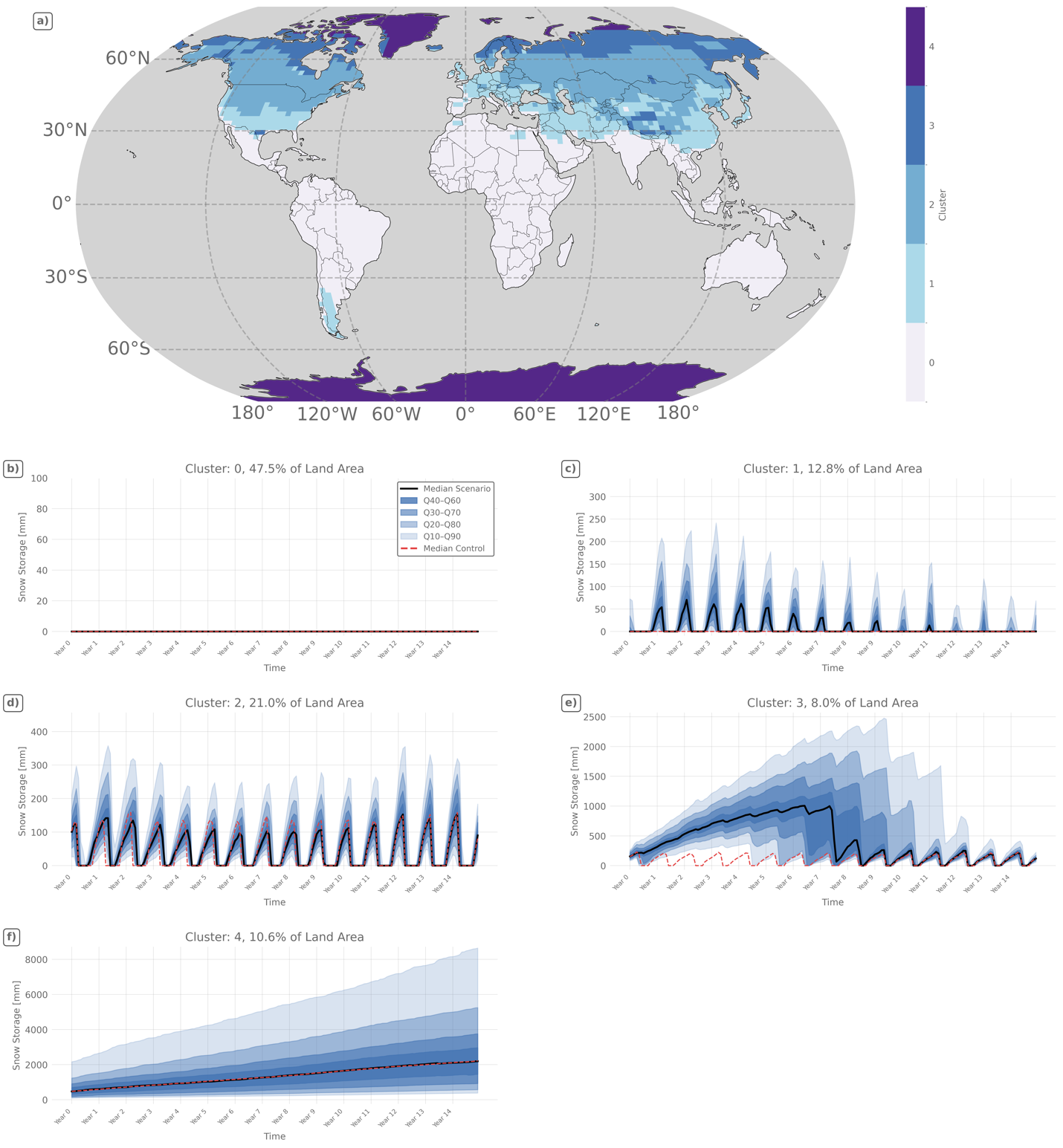
Figure 4: Snow accumulation regimes during nuclear winter (47 Tg).
This shows quite a distinct change in how snow accumulates globally, as three regional patterns emerge: new seasonal snowpacks, prolonged snow seasons, and multi-year accumulation at high latitudes. In northern Russia, Scandinavia and Canada, snow stops melting altogether. For about six years it just accumulates, reaching a median of around 1,000 mm of water equivalent. That is roughly 2.5 to 3.3 m of settled snow, and 6 to 8 m in the snowiest places.
All of these would have consequences for infrastructure and human societies in general, as they change things like snow load on buildings, burying roads and railways, river runoff behavior or filling up of drinking water reservoirs. When the snowpacks suddenly melt when the climate returns to normal, this could lead to unprecedented floods. These could also happen in areas that are not used to large floods due to snow melt.
Conclusion
All these things would happen in parallel, while also occurring in a time of general disruption. Heating demand would spike at the same time. Norway gets almost all of its electricity from hydropower and Sweden and Canada a large share, so snowpacks trapping water and frozen intakes could hit their power supply.
Most people in those areas would likely be without food, water, heating and electricity for years. Most of the research shown here looked at quite severe scenarios. However, it did not even account for the direct destruction that would be caused by the nuclear war. Factoring this in would make it much worse. Still, a nuclear winter could also arise from other countries fighting out a nuclear war, for example Pakistan and India.
I think it is quite important to remember that nuclear wars could impact even people far away from the impact. The people living in the northernmost countries should consider this most of all, as they would be hard hit, even from smaller nuclear exchanges far away. They likely even have the leverage for that. Most of these countries are in NATO, which gives them a lever to influence the nuclear posture of the United States.
References
- Blouin, S., Rivers, M., Hinge, M., Antonietta, M., Jimenez, I., Jehn, F. U., & Denkenberger, D. (2025). Strategic crop relocation could substantially mitigate nuclear winter yield losses. EarthArXiv. https://eartharxiv.org/repository/view/10178/
- Coupe, J., Bardeen, C. G., Robock, A., & Toon, O. B. (2019). Nuclear Winter Responses to Nuclear War Between the United States and Russia in the Whole Atmosphere Community Climate Model Version 4 and the Goddard Institute for Space Studies ModelE. Journal of Geophysical Research: Atmospheres, 124(15), 8522–8543. https://doi.org/10.1029/2019JD030509
- Lamilla Cuellar, J. E., Palm, R., Denkenberger, D. C., & Jehn, F. U. (2026). Frost depth increase under a nuclear winter scenario projected to sever piped-water access in the Northern Hemisphere. Water Security, 27, 100193. https://doi.org/10.1016/j.wasec.2025.100193
- Wöstenberg