What would happen if the Atlantic Meridional Overturning Circulation (AMOC) collapses? A frozen Europe or just somewhat cooler seasons? It seems like the scientific opinion differs wildly in their assessments and public concern seems to be on a strong upward trajectory. Iceland even flagged AMOC collapse as a potential national security threat, showing that people are starting to take the danger seriously. So, let’s explore the different view points.
What even is AMOC collapse?
First, let’s map out some basics of what we are even talking about. To get a broad overview, there is a great fact sheet by the UK’s Met Office (2025). The AMOC is part of the ocean currents that distribute heat globally. In parallel, the wind driven Gulf Stream helps bring warm water from the Gulf of Mexico towards Europe’s coasts. There the water cools, sinks down and flows south. All of this is powered by the density of the water, which is driven by salinity and heat.
As the climate warms, the salinity is diluted by melt water from the Greenland ice sheet. Also, the water in the North generally stays warmer, due to higher ambient temperatures. When both are combined, this means less water is sinking down, removing the motor of the current. However, a part of this is also driven by wind, so likely this would continue some of the current, even if the density driven mixing declines.
The re-distribution of heat by the AMOC is quite important for Europe. Without it, the European climate would be much cooler. This could completely offset warming by climate change in the region. Though, while this sounds like an okay outcome, the problem is that this is just for the mean temperature. However, the distribution of temperatures throughout the year would also change. In particular, the winters could cool down dramatically and some parts of Scandinavia could feel temperatures as low as -30°C in winter. Also, as this would lead to a stronger heat difference in the Atlantic, this could also lead to much more extreme weather and stronger storms reaching Europe.
The effects are not linked to just Europe. As the AMOC distributes heat on a global scale, we could also see changes in other parts of the Earth. This includes a drying of the Amazon region and thus potentially a dieback of the Amazon rainforest, changes to the monsoon and disruptions of El Niño. Even if there are some places in Europe that would have some climate change consequences cancelled out for them if AMOC collapses, the global implications would be clearly negative.
The tricky thing is that the best datasets to understand AMOC (think currents, density, etc.) are all just a few years to decades old. The older data that exists is much more coarse. Also, how the oceans are represented in models varies quite a lot and thus the climate models allow a wide range of possible futures for the AMOC. However, what seems to be clear is that we can expect a slowing down. Though slowing down is not collapse and as we will explore below, the evidence for AMOC collapse is much more mixed.
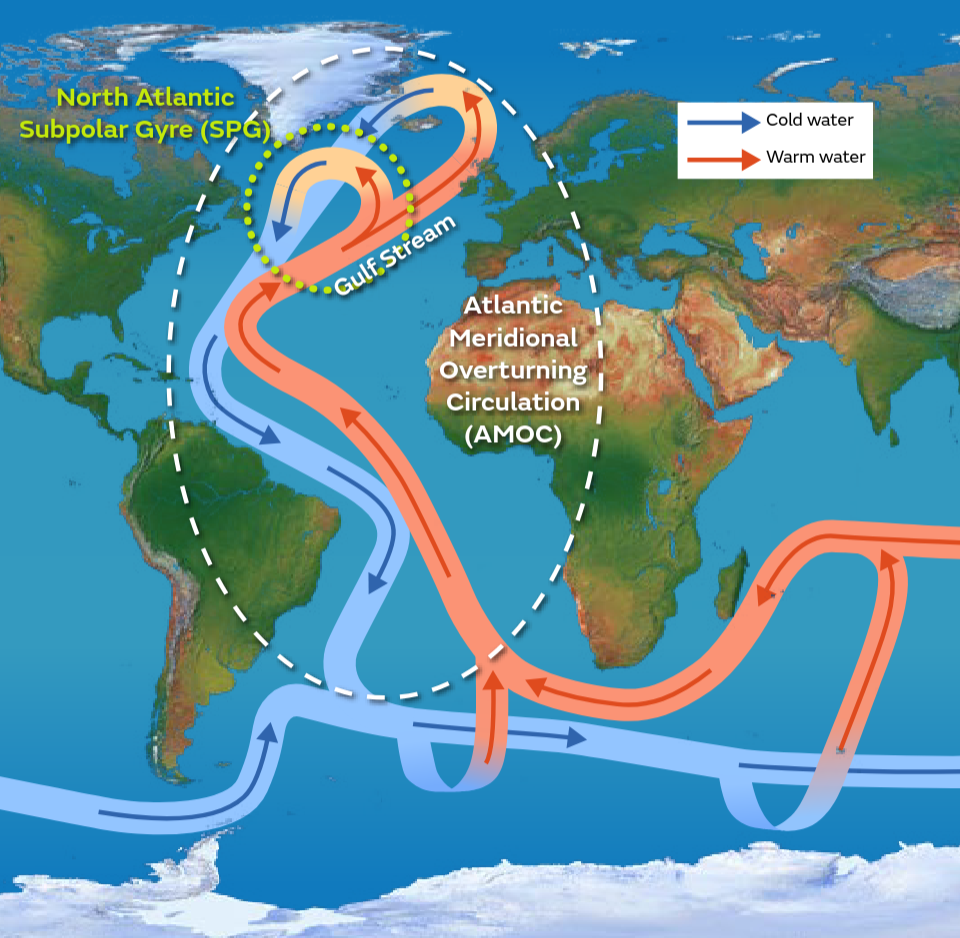
Figure 1: Schematic of AMOC. Red shows warm, near surface transport, blue shows cold, deeper transport (Met Office, 2025).
How likely is it to collapse? Why is everybody talking about it now?
This range of possible futures is also the reason why the topic has gotten much more attention in recent years. The fact is, the scientific community has known for a long time that AMOC collapse could happen. AMOC collapse is something that has been discussed as far back as the third assessment report of the IPCC in the early 2000s. However, in these discussions the general assessment was that this collapse would not happen this century, if it happened at all and thus it would not have to concern us now. This changed in the sixth assessment report, when the scientists concluded that they could not say with high confidence anymore that the AMOC would not collapse this century.
One big piece of evidence here that changed the discussion is study by Caesar et al. (2018). What they did was to run a climate model in which the AMOC slows down due to global warming. This gave them a simulated surface water temperature pattern for the last ~ 150 years. They then compared those simulated surface temperature patterns with actual measurements and found that the temperature patterns are consistent with the slowing down of AMOC and that especially in the last years the slowing down seems to be increasing.
What really kicked things off however, was a paper by Ditlevsen & Ditlevsen (2023). In contrast to the majority of studies before them, they predicted a collapse of the AMOC by mid century. They ground their assessment on mathematical signatures for a system approaching a tipping point. This is based on the idea that as systems are getting closer to a tipping point, their ability to restore itself after perturbation decreases. This shows up both in a higher variance signal, because the system’s self correction is not as powerful anymore and as the system takes longer to stabilize after disruptions. They find these two signatures in a long time series of sea surface temperature in the ocean south of Greenland and conclude from that that AMOC is slowing down. Using two separate methods to extrapolate from that, they come to the result that AMOC could tip by around 2060.
This was a shocking result and has produced much debate and more research since then. However, we should take it with a grain of salt, as it is built on a lot of assumptions and decisions that could have been made differently. For example, even in their own supplemental information they show that even slightly different assumptions around how they construct their proxy data would push the AMOC collapse into the next century. Similarly wide uncertainties are introduced by their mathematical tools (1).
There has also been follow up work, which is more directly grounded in physics. For example, van Westen et al. (2024) used the Community Earth System Model (CESM) to simulate AMOC tipping in a full fledged climate model. One of the main changes to previous attempts is that they make sure that the influx of low salinity water in the North Atlantic is more realistic. This leads the AMOC to slow down not due to the sudden, large influx, as in many other models, but due to more slowly shifting internal feedback of the simulated climate system.
They use their better simulations to come up with better ways to measure changes in AMOC in the real world and use those to detect the changes in AMOC. Their result is that AMOC seems clearly on the route to tipping, though the data is still too sparse to come up with a good estimate of when it will happen.
So, the discussion around when AMOC will collapse is still very much ongoing and you will find people for both sides arguing very strongly for their timeline of collapse. It seems to me that the debate is slowly shifting towards taking the risk of AMOC collapse this century seriously. Even if the chance is low, the impacts could be huge and we should thus look more into it. This does not mean it has to happen, but spending more on understanding the likelihood and consequences seems very much warranted.
What are the consequences?
Interactions with other tipping points
AMOC is not the only part of the Earth system that can tip (2). There are several other tipping elements which could shift to a different state, like the Greenland Ice Sheet for example. While they can tip on their own, these different tipping elements can also influence each other. A review by Wunderling et al. (2024) highlights that the AMOC is the center piece of all these tipping element interactions (Figure 2). AMOC collapse could stabilize the Greenland Ice Sheet and Arctic Sea Ice, as it would lead to cooler temperatures in the North Atlantic. However, for all other tipping elements AMOC collapse could further destabilize them or the exact nature of the interaction is unclear or shows competing effects (like the southern part of the Amazon becoming wetter, while the north is getting dryer). For example, if AMOC collapses, this could further destabilize the West Antarctic Ice Sheet, as less heat is transported from the Southern to the Northern Hemisphere. All this means that a stable AMOC is extra important, as if it tips, we can expect many other consequences globally, besides just a cooler Europe.
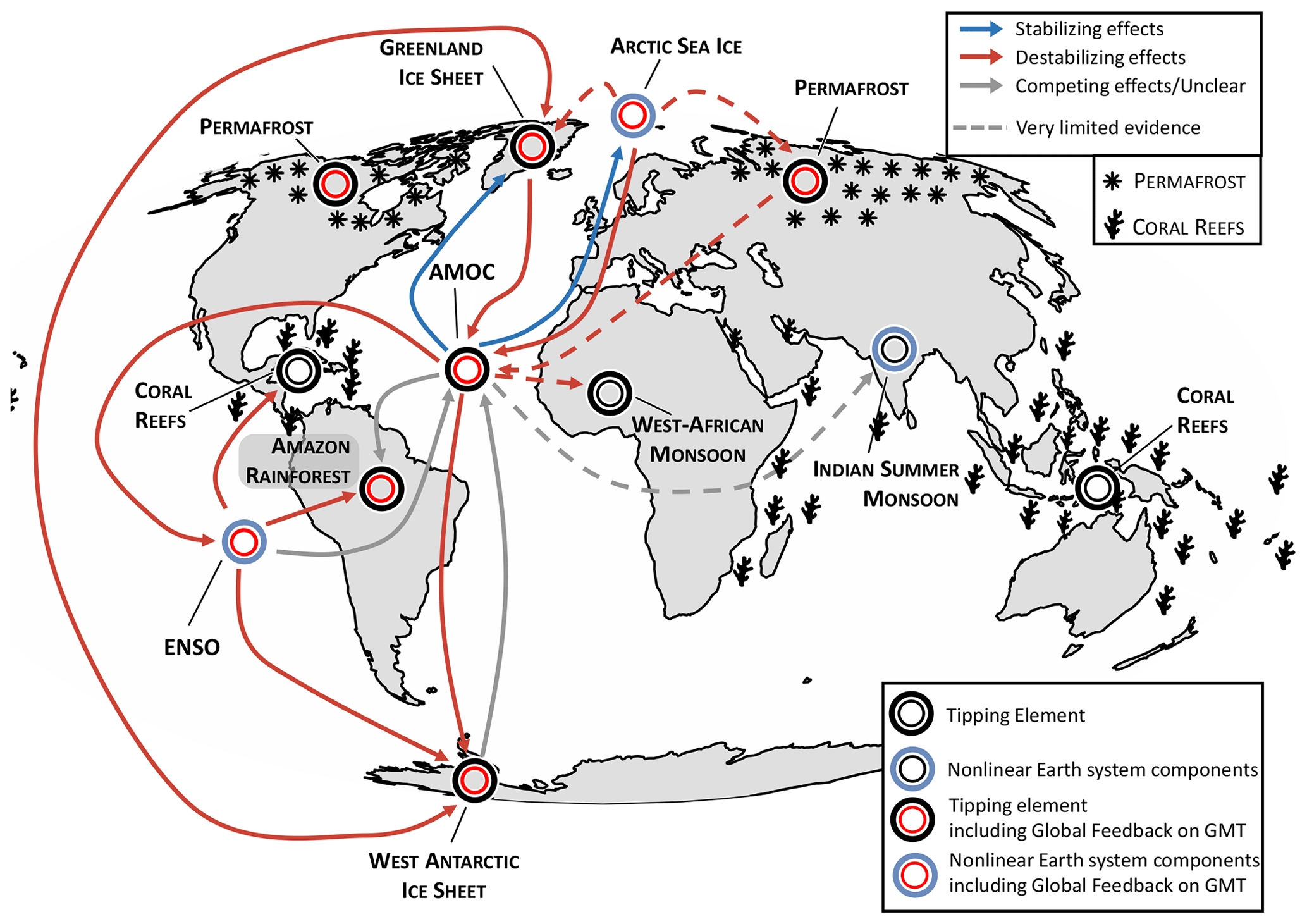
Figure 2: Interaction of tipping elements identified by the Wunderling et al. review.
Climate
But even if we just look at the climate impacts of AMOC collapse alone, without considering any further tipping effects, the impacts could be quite severe. One study that explored this in a lot of detail is Jackson et al. (2015) (3). What they did was to control simulations without any AMOC collapse and simulation where AMOC is shut down by a simulated large influx of low salinity water. Building from this, they go on to compare these to scenarios on parameters like precipitation and temperature. Their results show that this leads to a large redistribution of heat and precipitation globally. The changes in heat are pretty much what you would expect. The Northern Hemisphere cools down, especially in the North Atlantic Region, while the Southern Hemisphere generally warms up, in a more spatially homogenous way. The pattern change for precipitation is more varied (Figure 3). Here there are regions that are clearly more affected. Pretty much all around the equator precipitation declines, but especially in Central America and the Northern Amazon Basin.
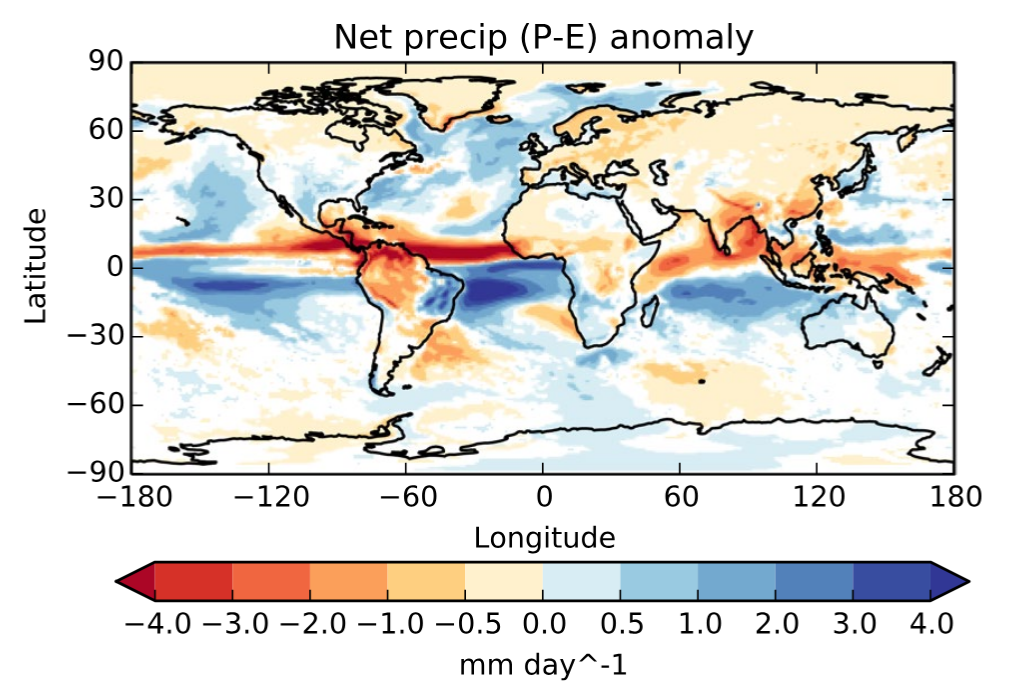
Figure 3: Net precipitation changes, which means the change in precipitation minus the change in how much water is lost due to evapotranspiration.
But these values are just for the yearly average. In Europe those changes are amplified in the winter (Figure 4). For many parts of Scandinavia temperature could drop an extra minus 10°C in the depths of winter, the UK could cool down 5°C and even the more continental areas like central Germany could still cool down 2-3°C. This could become highly disruptive, as many of those areas would face unprecedented temperatures and thus their infrastructure, housing etc. would not be adequate.
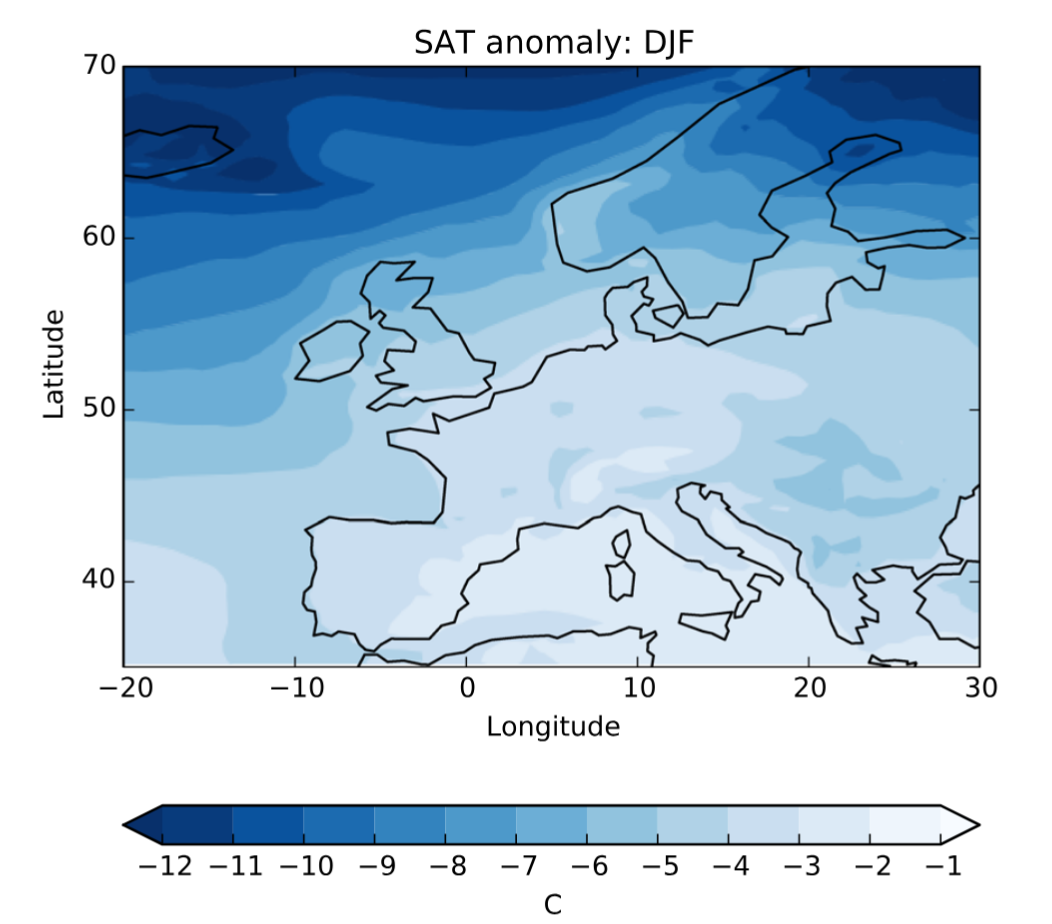
Figure 4: Temperature changes in Europe for December, January and February.
These changes will not happen overnight, but measured on the standard of Earth system changes, they are still pretty quick. The simulation from Jackson et al. showed that the shut down roughly takes 10 to 15 years. This means adaptation will be hard, but at least there is a chance to solve it if you have a decade to figure things out. Other papers like van Westen et al., which we discussed above, and which has a more realistic set up, comes to the conclusion that a collapse would take more like a century. If this were the case, adaptation would seem very manageable.
Agriculture
Every time you have a big change in climate, a large impact on agriculture follows. Strangely, there aren’t many good crop modeling studies around AMOC. A good one currently is arguably Ritchie et al. (2020). They modelled the impact of AMOC collapse for agriculture in Great Britain. The results are pretty stark. Due to changes in temperature, and especially precipitation most of the current farmland in Great Britain would revert to grasslands. This could be counteracted by widespread irrigation, but this would likely be prohibitively expensive in many places. They estimate that the damages to agriculture would be a magnitude larger than the ones by climate change alone.
There is also an assessment by the OECD (2021). Their report is generally concerned with all kinds of climate tail risks and also has a chapter on AOMC collapse. They did not run their own models, but re-analyzed the work done by others (e.g. the Jackson et al. paper mentioned above). This allowed them to also explore the changes in suitability for crops (Figure 5), following a combination of AMOC collapse and 2.5°C warming. They did not run a crop model, they just checked which cells would generally be in a climate range suitable for different kinds of crops and compared the results for the control run with the scenario of 2.5°C warming + AMOC collapse. They find in such a scenario that around 50 % of the land suitable for wheat and maize is lost, while rice experiences a slight increase in suitable area. These results sound extreme, but keep in mind that they did this analysis for the global land surface, not only the area where these crops are actually grown. The majority of places becoming unsuitable for wheat and maize did not grow these crops in the first place. Still, this analysis gives a good sense of the importance of AMOC for global climate and food systems.
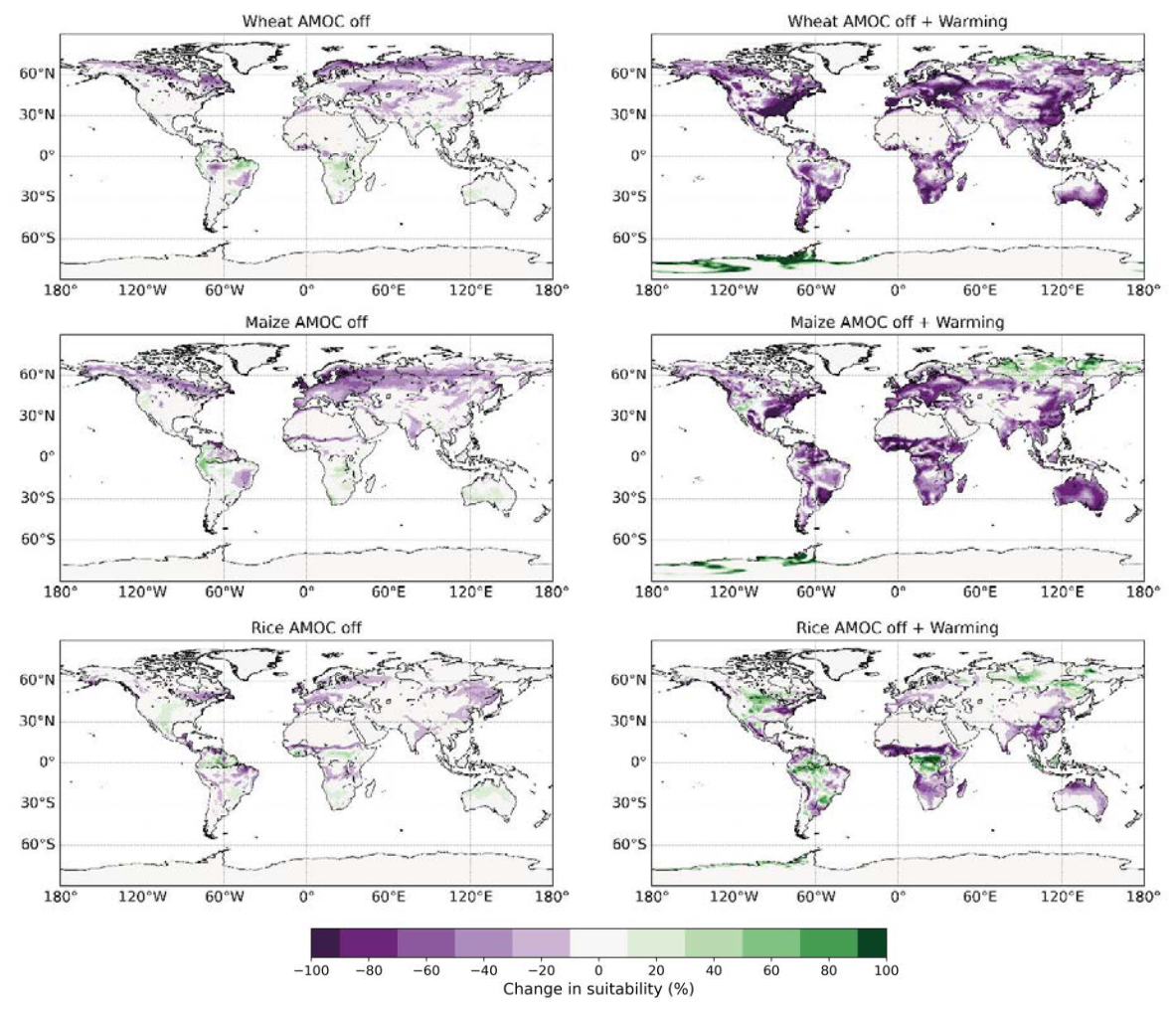
Figure 5: Changes in suitability for crop growth following 2.5°C of warming and AMOC collapse.
Besides these assessments, there is not much research to go on, but based on the changed patterns of precipitation and temperature, one could expect that agriculture in Europe more generally would be affected, as would those regions that have high changes in precipitation like India, Central America or parts of South-East Asia. These are all areas where a lot of food is grown. Though it is difficult to estimate those changes.
Conclusions
Given the evidence, it seems highly likely that AMOC will decline this century. The tricky question is how much and how soon? Given the state of research, I don’t think anybody can answer this question with a high certainty.
If it happens, the results are clearer. Especially, parts of Europe would likely have a very hard time adapting, especially the United Kingdom. And it seems likely that this could produce a major shock to the global food systems, if many productive regions in Europe are suddenly much less so and other, large food growing areas like India are affected as well.
Like so many of the risks discussed on this blog, this is yet another one of those events that have low likelihood, strong impact if it happens and we know relatively little about it. More research and general investments in resilience are clearly needed.
How to cite
Jehn, F. U. (2026, July 1). How much do we actually know about AMOC collapse?. Existential Crunch. https://doi.org/10.59350/sse7m-1nn58
Endnotes
(1) See Ben-Yami et al. (2024) for a detailed critique of Ditlevsen and Ditlevsen (2023).
(2) Tipping points are described in more detail in this post.
(3) See the more recent van Westen & Baatsen (2025) for a confirmation of the results from Jackson et al. (2015).
References
- Caesar, L., Rahmstorf, S., Robinson, A., Feulner, G., & Saba, V. (2018). Observed fingerprint of a weakening Atlantic Ocean overturning circulation. Nature, 556(7700), 191–196. https://doi.org/10.1038/s41586-018-0006-5
- Ditlevsen, P., & Ditlevsen, S. (2023). Warning of a forthcoming collapse of the Atlantic meridional overturning circulation. Nature Communications, 14(1), 4254. https://doi.org/10.1038/s41467-023-39810-w
- Jackson, L. C., Kahana, R., Graham, T., Ringer, M. A., Woollings, T., Mecking, J. V., & Wood, R. A. (2015). Global and European climate impacts of a slowdown of the AMOC in a high resolution GCM. Climate Dynamics, 45(11), 3299–3316. https://doi.org/10.1007/s00382-015-2540-2
- Met Office. (2025). Factsheet: The Atlantic Meridional Overturning Circulation (AMOC) (Met Office 02770). https://weather.metoffice.gov.uk/binaries/content/assets/metofficegovuk/pdf/research/climate-science/met-office-hadley-centre/amoc-factsheet-update-2025-v3.pdf
- OECD. (2021). Managing Climate Risks, Facing up to Losses and Damages: Understanding, Reducing and Managing Risks. OECD Publishing. https://doi.org/10.1787/55ea1cc9-en
- Ritchie, P. D. L., Smith, G. S., Davis, K. J., Fezzi, C., Halleck-Vega, S., Harper, A. B., Boulton, C. A., Binner, A. R., Day, B. H., Gallego-Sala, A. V., Mecking, J. V., Sitch, S. A., Lenton, T. M., & Bateman, I. J. (2020). Shifts in national land use and food production in Great Britain after a climate tipping point. Nature Food, 1(1), Article 1. https://doi.org/10.1038/s43016-019-0011-3
- van Westen, R. M., Kliphuis, M., & Dijkstra, H. A. (2024). Physics-based early warning signal shows that AMOC is on tipping course. Science Advances, 10(6), eadk1189. https://doi.org/10.1126/sciadv.adk1189
- Wunderling, N., von der Heydt, A. S., Aksenov, Y., Barker, S., Bastiaansen, R., Brovkin, V., Brunetti, M., Couplet, V., Kleinen, T., Lear, C. H., Lohmann, J., Roman-Cuesta, R. M., Sinet, S., Swingedouw, D., Winkelmann, R., Anand, P., Barichivich, J., Bathiany, S., Baudena, M., … Willeit, M. (2024). Climate tipping point interactions and cascades: A review. Earth System Dynamics, 15(1), 41–74. https://doi.org/10.5194/esd-15-41-2024