You are likely familiar with visions of doom. It is hard to avoid them these days. It’s scary, for sure. But are they helping? Looking at the world, they do not seem very effective. The USA left pretty much every environmental agreement you can think of, the EU always seems on the brink of rolling back important environmental rules. The backlash to green policies is real. But even more problematic is that we cannot even think about better futures anymore. If we look back, utopias have been a much bigger part of societal narratives. Once these narratives focussed on big topics like a strong welfare state or on civil rights. But they have disappeared. Not because they are not needed anymore, but because we have created an institutional machine for politics that systematically stamps out any alternative to the status quo. However, these positive visions are needed, as what we have now clearly is not working.
But how could we get those positive visions back?
This is a question that has been a lot on my mind lately. Fortunately, I came across the book “Captured Futures: Rethinking the Drama of Environmental Politics” by Maarten A. Hajer and Jeroen Oomen (2025), which I want to summarize here. It lays out a blueprint on how we ended up in the current world of dystopian futures, what forces shape our future thinking and what we might have to do, to be able again to envision futures worth fighting for and make them real.
Captured futures
First, let’s take stock of where we are at. Current environmental politics does not seem to be working. Climate change, biodiversity loss and many other environmental problems are ongoing and do not seem to be on a trajectory to be stopped soon. Partly this can be attributed to politics being captured by vested interests, but this cannot be all. What is more concerning is that there is a gaping hole where once ideas for a better future were. When we talk about tomorrow, it is usually in the form of a world that looks very much like what we have today, but either with a climate catastrophe in the background or that we somehow solved climate change and all our other problems without having to change much about how societies work. The visions of the future that are currently around are mostly not visions at all, but the status quo plus some changes around the edges. Given the magnitude of the challenge, it seems quite unlikely that these minor changes could be enough.
However, discussions on how a fundamentally different society could look like are happening far from the mainstream, if they are happening at all. The only thing the mainstream is discussing is the idea of ecological modernization. The idea of green growth, capitalism, but it is suddenly sustainable. No change in lifestyle needed, but miraculously the world is being saved from extreme climate change and all the other problems that are around.
These are captured futures. The collective inability to think about a future that could be fundamentally different from what we have today. Such narratives are strong, but it seems clear that they will not be able to deliver. Green growth capitalism is built around the idea of net zero. The ability to somehow remove carbon dioxide. We cannot do it now, because it is super expensive, but there is the strong belief that the market will solve this somehow and deliver carbon capture technology at some unknown point in the future. Believing in this is very convenient, because it alleviates all responsibility in the now. Why avoid emissions if they will be easily removable in just a few years?
But it becomes more and more apparent that this approach will not work. Countries in the Global South push for the rich countries taking on real responsibility for their past emissions, activists are radicalizing, scientists get more active in politics, hoping that this will get their message heard. The narrative of green growth and avoiding climate catastrophe without anyone having to change is starting to crumble. But what will come next and how does a society decide on narratives for its key challenges?
The shape of governance
What helps here is to see environmental politics or even all politics as a drama that is continuously playing and changing. In this dramaturgy everybody has a role to play. Scientists are supposed to keep warning us that the next ten years will be the last where we can change things, every year there are conferences like COP, which get much attention, but not really deliver much, leaders of industry warn that the changes needed are just too expensive, politicians weighing the evidence, so they can make the decisions for society.
In political reality, these roles are not as fixed as they might seem. Interest groups in society constantly shift and change. The political system we live in is not stable, but everyone in society is constantly shaping it, simply by living in it and either accepting or rejecting the premise of how power is working through society. One difference that is important to understand here is the one between policy and politics. Politics is the system of how your society makes decisions, the debate around the fundamental setup. Policy, on the other hand, are the rules and regulations you erect in the political system that you decided upon with politics. Policy always assumes a certain politics, usually without acknowledging it.
Another category we have to make sense of to understand how societies work is policing. Policing runs somewhat parallel to politics and policy. It is the act of re-enforcing the politics and policy that exists. This happens on many levels, often people are doing it without realizing it, as they have so deeply internalized the premises of the politics they live in, that they cannot imagine something else. An example of how the current environmental politics gets policed would be who gets invited to conferences like COP, whose arguments are heard and amplified during the conference and whose arguments are ignored. This reveals the limits of what the current political regime can incorporate or tolerate. Talking about carbon removal is okay, talking about ending capitalism is not. Arguments that leave the current set of acceptable ideas are actively suppressed, e.g. by not talking about them or by actively labelling them as preposterous.
For this to work, it was to be clear what should be governed, how it should be governed and the affected people have to care enough to do something about it. These prerequisites are slowly implemented through gradual interactions of scientists, journalists and activists. This attracts political actors who then transform the object from societal concern to governable object. The system of governance is not something that comes out of nothing. It has to be actively created, maintained and policed. Otherwise they would cease to function, as governance only happens in our collective imagination.
Enter dramaturgy
As governance happens in our collective imagination and does not exist as an external, objective fact about the world, this means it has to be constantly re-enacted. Once people stop believing in a form of governance, it ceases to exist. This constant remaking of our system of governance means that it is always changeable. Here visions visions of the future become important. How I imagine the future shapes what kind of governance I am willing to accept. If my vision of the future changes, so do the political systems I would tolerate to live in. We tend to forget this fact of politics. This happens because we want something firm to latch onto. If our current political system is just existing in our heads and could be changed at a moment’s notice, why should I adhere to society’s rules? This makes politics similar to theater. For theater to work and affect us, we have to ignore that it is all made up. We need to maintain a suspension of disbelief.
Therefore, concepts from theater can be used to better understand politics. Two important ones here are discourse and dramaturgy. Dramaturgy is about how actors wield symbolic power through performance. More specifically, it focuses on who says what, how, where and to whom. From a dramaturgy angle, politics is a sequence of performances. Discourse is the idea that our social realities are constantly reproduced by crafting narratives that connect past, present and future. Or said differently, discourse is the narrative of your society and dramaturgy is how it is acted out. Discourse is like glue, it allows to bring groups together and settle on concepts and narratives that they find convenient to interact. The interesting question that arises from this is: Why do some narratives persist, while others fail?
A history of the future
To understand the current state of environmental politics, we also have to understand how we even ended up here. Much of it can be traced back to the UN Conference on the Human Environment in 1972. Here the United Nations launched its environmental program. This made the environment an object of international governance. Since then the many parts of environmental politics have been institutionalized, professionalized and bound into clear processes of how things are supposed to work (e.g. the creation of the IPCC and its rules and regulations). This institutionalization has produced three main conventions that are held up high in present day environmental politics:
- Policy orientation: The current political system is seen as a given that cannot (and should not) be changed. This includes the focus on the nation state as the unit of action, the separation of market and state, the dominance of the market as a tool of social coordination and the acceptance that environmental politics is more of a side gig, happening far away from the centers of power.
- Separation of fact and value: The idea here is that there are experts, who work in the mines of knowledge, where they produce gems of pure fact. They deliver those pure facts to policy makers, who make the value judgement of how this fact should be interpreted and weighed. This also has led to a “supremacy” of the natural sciences, as they can always claim, that they were just measuring reality. This ignores that who is seen as an expert and what counts as a fact are also value judgements.
- Institutionalized science-policy interface: The science-policy interface is a set of political, institutionalized routines that define issues for political decision making.
These three conventions are very important to maintain the status quo. They are needed for the belief that the miracle of economic growth without impact in the world is possible.
An alternative view of how these things should be valued and judged can be found in grass root movements, which focus on preventing local, environmental damage. Originally, much of this started from the counter culture in the United States, which had coalesced around issues like protest against the Vietnam War. This also spread to Europe. These movements fought against the destruction caused by new airports and roads and the inherent danger of nuclear power. This was also the birthplace of movements like Greenpeace. They all were united by their concerns about mass consumption, pollution, capitalism and imperialism. These movements were quite strong in the 1970s, but they ran out of steam in the 1980s. As they declined in importance, the main societal narratives became tamer and mostly ended the critique of capitalism. In parallel, protest about environmental politics was more and more funneled into narrow, accepted forms of protest, like side events at global conferences.
The new dominant story around the environment became the idea of ecological modernization (aka green growth). A story based around the beliefs that saving the environment and economic growth are compatible, experts should explain how much the system is under stress and suggest technocratic solutions, market based solutions are key and consumers should just make the ethical choice on their own, the current state of capitalism is the only possible societal system and that companies should be guided by regulatory frameworks.
As the environmental protest was domesticated, the narrative also shifted around lifestyle changes. The way you live your life should never be changed from the outside. No sacrifice should be demanded of the individual consumer. This depoliticized many, as it meant that they could reasonably expect that their own life would not change, no matter what happens politically. In parallel, the focus on “the expert” was emphasized. Only experts could create knowledge that is suitable for policy discussions. Ideas from the public are only worth considering, if they have been endorsed by an expert.
This led to a stale vision of the future. A future that is basically like now, with the only difference being that experts somehow solved the environmental crises we are facing. Nobody would have to change their lives. The problems would just be gone in some not too distant future. The only crux being that this vision of the future has failed. The magical fix to capitalism’s environmental problems hasn’t manifested itself. We are still overusing our resources, we are still overstepping planetary boundaries, we are still accelerating climate change. New stories about the future are needed.
Constructing futures
But how are new visions of the future actually constructed? The future is the eternal “not yet”. It exists only in our imagination. It motivates our actions, because it can still be shaped. All human agency is projection into the future. This means future is more of a verb. Something we do, something we engage in.
In the 20th century, the future was often associated with progress and opportunity. Much of this view was centered around geopolitics and the struggle of political systems. Especially, the struggle between the United States and the Soviet Union was a struggle about the future. Both sides employed scenarios to project out a different tomorrow. Those were not meant as accurate representations of what might happen, they were meant to support decision making. Make the future predictable and controllable by having something to aim for. This lent itself to quantified predictions.
When the United Nations started its focus on the environment, they did so in a world that relied a lot on quantified predictions, and so they employed this tool as well. They used those predictions to paint dystopian futures, where the world was so out of balance, that it ceased to be a good place to live. The idea was that this would motivate people to act. They also avoided painting any aspirational futures. Any attempt to aim towards a new utopia was seen as a shortcut to the totalitarian regimes of fascism and Stalinism and thus had to be avoided at all costs. Stories about the future shifted more towards how society should organize and how an open society can maintain itself. A more technocratic vision of maintaining the status quo.
In parallel, there were still scientists who studied futures and how they are built. They identified key ways on how we are actually constructing the future. One important feature here are expectations, affect and aspirations. They all focus on the ways we might want to bring the future into being, with expectations focusing more on the rational part and affect and aspirations on the emotional. Expectations make the future legible, while affect and aspirations make the future desirable. When many people are doing this at once, you get a collective imagination, the collective vision people in a society have about what they think their future should look like.
When we talk about the future, we usually keep several competing alternatives in mind at once. We implicitly sort them by how likely they might be, ranging from just extrapolating the current trendlines into the future, to things we deem so outlandish that we deem them impossible. However, these are not stable categories. What we see as a continuation of the present and what we see as outlandish changes over time. Things that once seemed impossible, can become the default expectation. How and why this change is shaped by the past experience we have. Thus, you can see the way futures are constructed as a prism. The present is the center point, where we refract past experiences into the future (Figure 1).
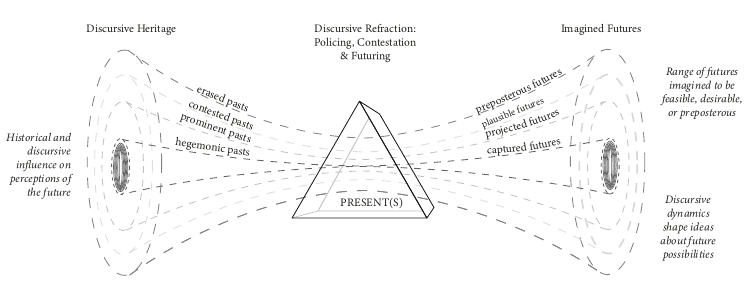
Figure 1: The future prism.
Given that the idea of the future shapes what we do in the present, the future is often used as a justification of how the present should be governed. The struggle about which futures we talk is the struggle about which world order, society and geopolitics we want. To have your vision of tomorrow win in this contest, it has to be influential, credible and desirable. But instead of making your vision more competitive, you can also try to decrease the availability of alternative futures. If you manage to push alternatives into the realm of people seeing them as preposterous, your vision of the future can rule, even if nobody really likes it.
This is the state we are currently in. Societal discourse has pushed all visions of the futures that are fundamentally different to the present so far into the fringes, that the technocratic vision of just continuing as is, can stay the main future that is discussed, even though people are noticing that what we are doing is not working. Only now, as the world becomes ever more unstable, this narrative of the eternal present is starting to crack. When the idea of the future we share in the collective imagination is seen by more and more people as impossible, the time for new narratives has come.
The stale present
Before we go more into these new narratives of the future, first let’s shine some more light on the cracks of the current dominant vision of ecological modernization. We are all still looking forward to fulfilling the American Dream. The dominant view of the future still is that everybody will be able to afford a house, a car, which they can share with their nuclear family. The majority of movies, advertisement and social media still showcase such aspirations to strive to. Similarly, any vision of environmental politics is only palatable, when it does not preclude the possibility of achieving the American Dream.
This is why the dominant idea in environmental politics right now is the idea of net zero. Net zero really became strong after the Paris Agreement. In the Paris Agreement, the goal of limiting warming to 1.5°C was enshrined. This goal was a surprise to everyone, as 1.5°C had been deemed impossible to achieve by the scientific community and so almost nobody did much research about it. However, during the discussions before and at Paris, it became apparent that a 2°C warming would doom several UN members (e.g. the Maldives) and the United Nations could not agree to a goal with such consequences. Therefore, 1.5°C was declared the new goal instead, as it would not endanger some countries so extremely. Scientists rushed to produce research around this new goal, which they had previously ignored (1).
The new research hardened the previous suspicion by the scientists that the goal could not be realistically reached with emission reductions alone. Therefore, the idea of negative emissions was introduced in the modelling efforts. Negative emissions just means the removal of excess carbon dioxide after it has already been emitted, the invention of the idea of net zero. Net zero is quite a convenient idea if you do not want to change the status quo, as if you just add more negative emissions to your projection, 1.5°C remains forever within reach, no matter how much you emit.
To give these models their authoritative power, they were nominally grounded in the physics of the climate system. A mathematical and physical foundation makes every scenario feel more solid. However, if those models not only include climate estimates, but also assumptions around how societies will react, things get murky fast. But still they are favored in the current technocratic regime, as they seem very solid as evidence. If you don’t look too hard.
Due to their mathematical foundation, models can easily be framed as an objective representation of reality. However, every time you build a model, you have to make lots of value judgments. What are the boundaries of your model? What processes do you include? How do you represent these processes mathematically? And this is where we get back to how environmental policy is done today. The assumptions of the models are policed, just like everything else in societal discourse. Scientists only put those assumptions in their models, of which they know that their colleagues will accept them. If they are working on models that are meant for guiding policy decisions, they also only include those assumptions of which they think the policy makers will accept as plausible.
Therefore, models are strongly shaped by the environment they are created in and as thus also constrained by what futures are imaginable. We can see how this plays out if we look at how models implement lifestyle changes. In many cases they simply don’t. They just project current consumption and inequalities in the future. While this is the most easily defensible assumption, it is also the assumption that leads to the least ambitious policy proposals, as all the levers that would result in enough change to turn the ship around, are the ones that are assumed to be unchangeable. This only leaves net zero as your hope, as it is the only proposal which promises no change in lifestyle and still stopping climate change.
The way models are created, also highlights the problem of framing environmental politics as simply pushing for what science recommends. Political viewpoints shape science, by shaping assumptions, by distributing funding, by deciding who is an expert. And the way the system is currently structured, this means that more extreme viewpoints never even find their way into the public discourse, because science does not recommend them, which in turn does not happen, because the public discourse does not demand it. A perfect discursive trap.
The last chance for ecological modernization
This discursive trap leaves us on a dangerous trajectory. By now it becomes ever more obvious that net zero will not deliver, while at the same time the borders around lifestyle changes are still policed strongly enough that suggestions in this direction remain off the table. Therefore, a new, better technofix is needed to maintain the belief that we can extend the present into the future without any changes to how society works.
This new technofix is geoengineering and especially solar radiation management (SRM). SRM ticks all the boxes. It is a technical solution to a social problem, it can be nicely quantified and modelled and it can be tied to apocalyptic visions of the future (geoengineering or climate collapse!). Aren’t we in a climate emergency? Doesn’t an emergency justify every action possible? Don’t the ends justify the means?
The focus on geoengineering has been building momentum for quite a while. The idea first gathered some attention in the 1970s. However, at that time it was seen as too dangerous and reckless by most. But still it had some powerful backers in the form of people like the renowned (or rather infamous) Edward Teller. In the 1980s it started to slowly gain more traction. Mainly on the basis of cost-benefit calculations. Many people tried to keep it far away from the mainstream discussions, but in the 2000s politicians started to suggest that geoengineering should at least be considered, as a kind of final resort, if all else fails.
In the 2000s the amount of research around the topic started to grow much faster and by now it is openly discussed and there are even startups forming to profit from its potential implementation. More and more think tanks and research institutes started to look into the topic or include it in their modelling runs, to gauge its potential. The way it was introduced into the mainstream debates was built around three main pathways:
- Shifting discourse: Frame geoengineering as a last resort, which we need as a backup for society.
- De-facto governance: Geoengineering exists in a pre-governmental space. It is not yet developed enough to easily slot into existing frameworks. Large scientific reports work as a kind of rallying point for new topics and also did so here. They introduce definitions and allow people to talk more easily about the topic.
- Extrastatecraft: Think tanks and similar organisations can further shape the discussion by proposing new rules around the topic, which makes it easier for others to implement it as policy. For geoengineering an important debate here was about cooling credits, which would have allowed companies to sell claims of cooling they have caused, so other companies could emit more.
While it is quite concerning that geoengineering is gaining ever more ground, it also shows what properties ideas have to have to thrive in the current state of environmental politics. They have to be based on scientific assessments, include ready made policy suggestions, must be engaging enough to be covered in the media and allow somebody to earn money with it.
This does not mean that these are the properties that all future proposals should have, but what makes ideas successful in the current regime. If we want better futures to be discussed, we also have to change how the discussions happen. We have to pry open the discursive space, so that arguments are possible, which do not automatically assume lifestyle is something that can never be changed. It can be changed, it has in the past and it has to change again, so this planet remains a good place to live. And these liberated futures do not have to be ones of asceticism. They can also be bright and positive.
Vivid visions of a better tomorrow
Environmental politics has to be re-invented if it should be able to help us in the coming decades. Currently, the debate is mainly focussed on arguing that we have to act, because otherwise we are doomed. But did it work? If we look around, the backlash to environmental politics is happening in many places. Some of this even translated into distrust of science. This path is a dead end.
We need to find the deep leverage points in society. What could be done to bring actual change? This deep leverage point is culture. Modern culture is strongly focussed around fossil fuels. Cheap and easy energy has been taken for granted. Such a life assumes energy in abundance and does not care about preservation. It also means that people deeply embedded into this lifestyle see any discussion around fossil fuels as a threat to their good life. Giving up on fossil fuels feels like giving up on a better future. This is also where many far right populist parties are making their arguments. They connect staying with fossil fuels, with staying in the zone of comfort. If you only focus your argument on the looming catastrophe, you have nothing to offer here. To move on, we have to understand where these wishes are coming from and what could replace them.
We have to change the culture around what we believe a society should look like. Only if you change those expectations, there is an alternative you could offer. Take cars for example. Cars are so dominant because everybody believes them to be essential. But there are other modes of transport which could work just as well or even better. The Netherlands was totally car centric in the 1960s, but over decades they have shifted their culture to view bikes as much more desirable. Now they have a better life and less cars. These things do not have to be in contrast.
The current culture can seem like a solid monolith. Unshakeable. But each and every one of us has leeway in the decisions we make. Even a lowly clerk has leeway on how they implement or enforce laws and rules. What is possible in society is in constant renegotiation. Rivers are getting rights on their own now in many countries, to protect them better. This would have been totally unthinkable just a few decades ago. And now it happens so often that newspapers do not even report about it anymore. This is the kind of cultural shift we need.
Talking about values
Politics is downstream of the culture we have and culture is downstream of the values we have. This means if we want a new environmental politic, we have to talk about what we value as a society. This is possible. The current environmental politics did not come out of nowhere. It has been building up for decades and it started with people discussing what they valued. A lot of such changes happens via language, a current discourse that shapes values is around the idea of the Anthropocene, but also other ideas like the focus on the economy or the belief in GDP as discursive constructions that shape how we think about politics.
As there has been changes in discourse and values in the past, we can also look into these past examples to try to understand why they worked. One of those projects that is changing the world right now is the rise of the current brand of conservatism. The discussion around the conservatism we have today started in the 1960s after Barry Goldwater failed to bring Libertarianism in the American mainstream. The voters rejected him and his ideas so hard that it looked like American conservatism was dead. But actually it was the starting point of what a more modern American conservatism should look like. Only after it had failed, it could be rethought. Over decades they built a new conservatism. A conservatism that is ultra capitalist. They invested in think tanks and in research to rebrand the ideas like markets, freedom and how they relate to each other. Much of this was financed by billionaires like the Koch Brothers. Them winning elections and finding their champion in Donald Trump is just the last step in a decades long struggle to rewrite narratives of how governance should be happening. This discursive project can be redone with more positive and prosocial ideas.
Movements in the moment
The good thing is that we do not have to start from scratch. There are already ideas out there about what a different world might look like. A world with different values, which produces environmental politics that actually preserves this planet.
Degrowth/Postgrowth
The basic idea behind this movement is that you cannot have infinite growth on a finite planet, but that this is okay, as economic growth is not necessary for a good life. Much is focussed on discussions of how a world without growth might look like and how we could reach it. It covers a fairly broad tent of people, but is generally left coded. It has been popularized by Kate Raworth with her concept of Doughnut Economics and the whole idea seems to be currently gathering steam. Especially with scientists who do not believe anymore that green growth is possible. It even has found some acceptance in political circles, but is still far away from mainstream. To be successful it would have to manage to rebrand economic growth as something harmful in mainstream debate.
Indigenous knowledge and environmental justice
While degrowth is especially active in rich countries, the Global South also has its own ideas. In many of these countries there exists resistance against the overwhelming focus on economic growth, as they have been scarred by their past experiences with Western enforced growth regimes. In addition, often nature and humanity are not seen as separate things, but facets of the same whole. This leads to new, different political visions, much of it focussed on seeing the Earth as alive, but there is a wide variability on these ideas, often differing considerably in their local implementation. Examples here include buen vivir in the Andes or ubuntu traditions in South Africa. Often ideas focus on how everybody should get their share, but only as long as it does not hurt others or the environment.
Eco-Conservatism
Environmental concerns are strongly coupled with the Left today. However, until the 1960s environmental protection was also a topic that many conservatives could get behind. The connection broke when environmental protection and criticism of capitalism moved closer, but it was never severed completely. A prominent example here is Roger Scruton. Many of his ideas are similar to degrowth, but he sees humanity more in the role of a steward, to protect and support nature. Similar to many left ideas, he also argues that many environmental problems could be solved if more power would be restored to local communities and by avoiding centralized decision making. However, the eco-conservatism movement currently lacks strong voices and is drowned out by other strands of conservatism.
New dramaturgies
Besides having a solid theoretical foundation behind the new ideas of environmental politics, what is also needed are new dramaturgies. New pictures and performances of the alternative ideas, which give people something to latch onto. Examples of such new dramaturgies would be how Greta Thunberg started her school strike or how Ende Gelände managed to create eerie pictures that really showed the destructiveness and surrealism of using fossil fuels. In the current flooded information ecosystems such beacons are even more important. People can only flock around a new idea if they become aware of it. There are many different ways to create these beacons, both in negative and positive ways. What they all share is that others will see you as weirdos if you work on them. But this has to be tolerated. You cannot get approval from everyone if your aim is to restructure society. The larger the change is that you propose, the stronger the system will resist. What seems clear is that the push for change has to come from outside of the captured politics. If they could have saved us, they already would have. And there are many dramaturgies to pick from if you want to start.
Dramaturgy of backlash
Environmental politics is often in a double bind, that it wants to maintain agriculture, but also that it wants to avoid the negative environmental effects of agriculture. This has led to farmer protests in many countries. Every time fossil fuel subsidies are cut without any compensation people suffer and do not feel heard. Often there is a mix with general grievances. If you are already downtrodden, saving the environment can easily feel like the hobby of spoiled elites. Such protest is often co-opted by populist parties. While it can be destructive, it also shows that these groups can be mobilized for politics. Right now this is often against environmental politics, but with the right offers, this could be changed.
Dramaturgy of moral protest
Politics is going back to the streets. There is a larger focus of being visible to get attention and thus leverage. It is the attempt to make the problems visible that society is working hard to ignore. One effective way to go about this is by showing the hypocrisy of the rich. For example, Extinction Rebellion blocked the private jets at several airports in 2023 to make visible the raw immorality of private flight. There are also past examples of where such protests were very successful. Animal activists managed to rebrand fur from luxury to moral failure. Similarly, fossil fuels could be reframed around ideas like stranded assets.
Dramaturgy of litigation
One important lever is the courts. In many cases existing laws are already strong enough to protect the environment. They just aren’t enforced enough. One very powerful argument here that is applicable across many countries and sectors is the duty to care. The state has to make sure that its citizens are not unnecessarily harmed. The effects of climate change can be such a harm and thus if the state does not work hard to prevent these damages, it is working against its own laws. The added benefit of winning such cases in court is that courts get inspired by each other’s arguments, meaning if one court finds a case or argument that successfully wins a climate change case, this is often re-used by other courts.
Dramaturgy of financial risk and opportunity
Just fighting about politics will likely not be enough. But there are other levers of power. The whole finance sector is starting to realize the dangers it will face due to climate change. Ideas like stranded assets are spreading. Companies have to re-invest if their shareholders get the impression that they are making themselves too vulnerable for climate change. Another powerful actor here is reinsurance. If the reinsurers are convinced that in certain regions or asset classes climate change is becoming too large a risk to be insurable, they can trigger massive shifts away from fossil fuels.
Dramaturgy of democratic practice
Alternative democratic practices are gaining momentum (2). This includes things like citizens’ assemblies. They have been successful in countries like France, Ireland or the United Kingdom. They clearly showed that even ordinary citizens can be convinced of radical climate action, if they have the time and information to think about it. Right now these alternative forms of democratic practice are often kept away from true societal power, but it does not mean that this has to stay that way. There are countries that employ this more than others (e.g. Switzerland) and even that level does not have to be the end point.
Dramaturgy of futuring
The current dramaturgy does not offer positive visions. It is just about solving problems and avoiding catastrophe. Better futuring needs to combine political strategy, citizen engagement and art to create visions of the future in the now. The future we want often already exists, it is just unevenly distributed. Show politicians that the goals we have that they deem impossible already exist. You cannot argue away an alternative future, if you are able to just walk through it. For this to work, we constantly need people working on new ways to organize. More communal cities, community gardens, shared living projects, bikeable city quarters. These are all things that we have today, we just need more of it.
Dramaturgy of radical incrementalism
Citizens are often able to find quite radical solutions if they are just given the opportunity to do so. For example, South Africa faced a lot of blackouts due to mismanaged electrical grids. Over years ordinary people slowly, but surely started to build solar powered microgrids. These slowly grew over time to a scale that was so large that it helped stabilize the whole grid. Often what is needed is just a clearly defined goal and the leeway to work towards it in creative ways. Radical incrementalism is a politics of becoming, a revolution from below to create small enclaves of experimentation, which can kick start new strands of ideas and movements.
Dramaturgy of violence
Violence can be effective. We often do not like to admit it, but even just a threat of violence can help bring change. Partly this might be because more extreme strands let the rest of the movement seem more tame in comparison. For example, in the United States the civil rights movement seemed less radical if it was compared to the Black Panthers. More extreme activists imply the threat of escalation down the line if needs are not met. Rejecting violence outright can also be seen as a kind of imaginative capture. Without at least some violence many of past successful struggles for more freedom would not have worked. The hard question is just how much and what kind of violence can be justified.
What next?
The current approaches are not enough. We have to make clear that fossil fuel based industrial modernization was just a stepping stone for the next phase of civilization. People need a vision of the future. If you don’t know where you want to go, it is just too scary to even get moving. Currently no such shared vision of a positive future exists. We just have a spectrum of possibilities. Maybe we need to change our economic system to something completely new, maybe we need to rethink how we relate to nature.
One story we could be telling is a story of regeneration. Repairing the damage of the last centuries. Working to make the world whole again. It is a positive story, as it shows that there is something worth restoring, something worth trying. We can also start to familiarize ourselves with utopias again. Think about how a better world could look like. We might never reach it, but it is good to have a guiding star.
As you might have gathered from this summary, I agree a lot with this book and it has sharpened many ideas for me that only existed as vague shapes in my head. I think its argument goes beyond just environmental politics. Societal collapse is also a narrative of doom and we have been discussing it a lot on this blog. What I have tried in some of my writing is highlighting that we can also make societal collapse less likely by aiming for better futures. Especially, reducing inequality and increasing democratic participation seem like great ways to have a better future to aim towards that also reduces our chance to fall prey to collapse. Low inequality, highly democratic societies are both those that are best to live in and also the ones that have the highest chance of avoiding bad outcomes.
I just hope that we do it quickly enough. While I agree that change is possible and something worth working on, it might just be too slow for all the problems that seem to loom ahead. Though ultimately, we cannot know and so we should try anyway.
But no matter where we ultimately end up, one thing is clear: this is the age of politics.
Endnotes
(1) We have discussed this mismatch in research focus in another post.
(2) We have talked about this a lot in this post.
References
- Hajer, M. A., & Oomen, J. (2025). Captured Futures: Rethinking the Drama of Environmental Politics. Oxford University Press.